
John Moses Browning
A Utah gunsmith and prolific designer whose patents shaped the modern rifle, pistol, and machine gun.
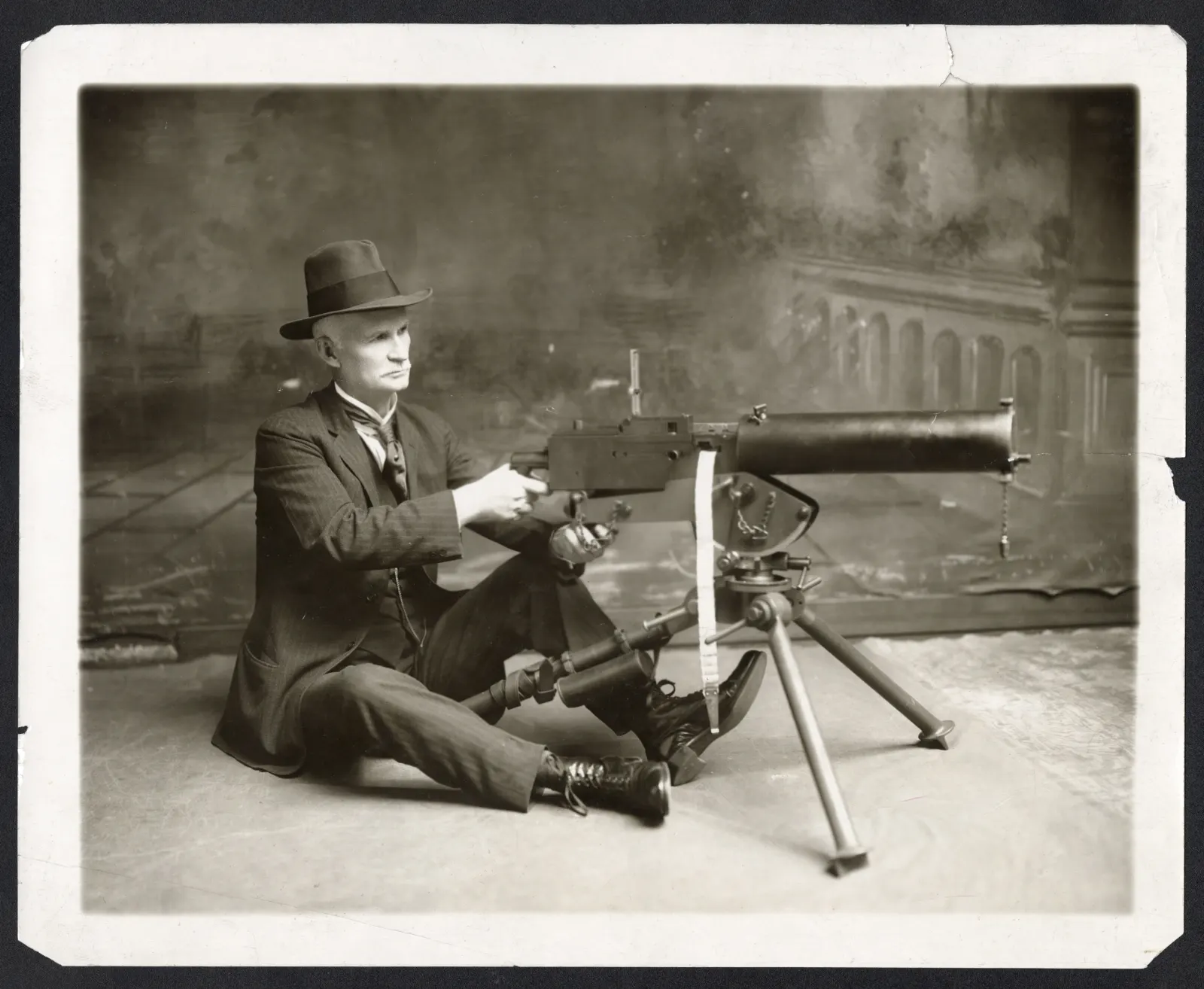
Photo: Unknown photographer; source image via the National Museum of the U.S. Air Force via Wikimedia Commons[1]. Public domain[2].
Profile
- Born
- January 23, 1855
- Birth place
- Ogden, Utah, United States
- Died
- November 26, 1926
- Death place
- Liège, Belgium
- Nationality
- American
- Role
- Firearms inventor and designer
Firearms connection
John Moses Browning learned the trade in his father Jonathan’s Ogden gun shop and began designing firearms as a teenager. Over a career of nearly six decades, he produced more than 100 firearm designs and held 128 patents. His work includes the Model 1885 rifle, the Model 1892 rifle, the Browning Automatic Rifle, the M1911 pistol, the M1917 and M1919 machine guns, and the M2 .50-caliber machine gun.
Why John Moses Browning matters
Browning’s importance is not only the number of designs, but the durability of the mechanisms behind them. The M1911 served as the U.S. military’s primary sidearm until 1985, and his machine guns served across major theaters of the Second World War. Many modern firearms still use mechanisms he developed.
Life and firearms
John Moses Browning was born in Ogden, Utah, in 1855 and grew up around his father’s gunmaking and repair work. In 1878, he designed a single-shot rifle that became the Winchester Model 1885, beginning a long relationship with major firearms manufacturers.
His later designs reached across sporting, military, and civilian firearms. The M1911 pistol, the Browning Automatic Rifle, the M1917 and M1919 machine guns, and the M2 heavy machine gun are among the best-known results of his work. The United States Army credits Browning with 128 patents and more than 100 different weapons.
Browning’s legacy is unusually visible: designs created more than a century ago still influence how firearms are built, carried, and maintained. He died at the FN factory in Herstal, Belgium, in 1926 while working on another firearm design.
Photos of John Moses Browning with Guns
Known John Moses Browning Quotes About Guns
“I found a good starting place, a fixed point – like the North Star, for example – from which I could make exact calculations. Then I calculated.”
– John M. Browning, as quoted in the Deseret News.
“And in the matter of guns, that makes me crazier than most.”
– John M. Browning, as quoted in the Deseret News.
“The object which I have had in view has been first and mainly the production of a firearm which should be not only practical, efficient, and perfectly safe in use.”
– John M. Browning, US580924A patent specification, 1897.
“…very simple in construction and therefore much less liable to get out of order.”
– John M. Browning, US580924A patent specification, 1897.
“The rate of firing may be so rapid that the shooter can not properly aim his gun or rifle, ammunition is wasted.”
– John M. Browning, US1511262A patent specification, 1924.
“The rate of firing may be so rapid … as to be a positive disadvantage.”
– John M. Browning, US1511262A patent specification, 1924.
Sources
Footnotes
- commons.wikimedia.org Back to reference 1
- creativecommons.org Back to reference 2
- commons.wikimedia.org Back to reference 3
- commons.wikimedia.org Back to reference 4
- www.browning.com Back to reference 5
- www.britannica.com Back to reference 6
- www.deseret.com Back to reference 7
- patents.google.com Back to reference 8
- patents.google.com Back to reference 9