
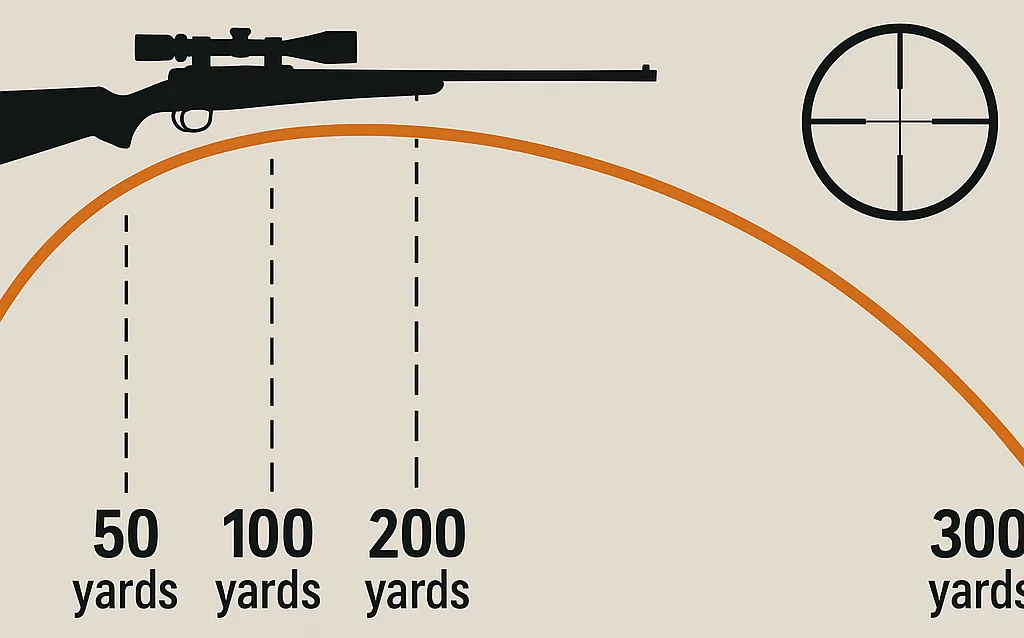
Bullet drop trajectory is the curved path a bullet follows after it leaves the barrel. Gravity pulls the bullet down for the entire flight, while the bullet keeps moving forward toward the target. At short distances the change can be small. At longer distances, the drop becomes large enough that the shooter has to account for it.
The key idea is simple: bullet drop is the downward movement of the projectile, while trajectory is the full path of the bullet compared with your sights. A good zero does not remove gravity; it only sets where your line of sight and bullet path meet.
Quick Answer: Why Bullets Hit Low At Distance
Bullets hit lower as distance increases because gravity has more time to act. The bullet is also slowing down as it travels, which gives gravity even more time to pull it down. That is why the same rifle can be close at 100 yards but noticeably low at 250 or 300 yards unless the shooter holds over, dials elevation, or uses a reticle mark.
Bullet Drop, Bullet Path, And Zero Distance
| Term | Meaning | Practical use |
|---|---|---|
| Bullet drop | The projectile’s downward movement caused by gravity. | Explains why point of impact gets lower downrange. |
| Bullet path | The bullet’s position compared with the line of sight. | Shows whether the bullet is expected to hit high, low, or near the aiming point at a given distance. |
| Zero distance | The distance where point of aim and point of impact are set to match. | Sets the reference point for the rest of the trajectory. |
| Holdover | Aiming above the desired impact point. | Used when the target is beyond the zeroed distance and the shooter does not dial elevation. |
What Changes A Bullet’s Trajectory?
Trajectory changes when the bullet leaves faster or slower, loses speed faster or slower, starts from a different sight height, or is zeroed at a different distance. A flat-shooting rifle load may need less correction at moderate range, while a slower or less efficient load may need more.
- Speed: faster bullets reach the target sooner, so gravity has less time to move them downward.
- Bullet shape: streamlined bullets hold speed better, especially as distance increases.
- Zero: changing from a 50-yard zero to a 100-yard or 200-yard zero changes where the bullet crosses the sight line.
- Optic height: higher sights change the relationship between the bore and line of sight.
- Conditions: temperature, altitude, pressure, and wind can all change real-world results.
How To Read A Trajectory Chart
A trajectory chart usually lists distance in one column and expected point of impact in another. Positive numbers mean the bullet is expected to hit above the line of sight. Negative numbers mean it is expected to hit below the line of sight. The chart only makes sense if you know the zero distance and load it was built around.
Charts may show inches, MOA, or mils. Inches describe target impact directly. MOA and mils describe angular correction, which is useful when your scope turrets or reticle use the same system.
How Shooters Adjust For Bullet Drop
- Confirm the zero. Start with the same firearm and ammunition you plan to use.
- Know the target distance. Range error becomes more expensive as distance increases.
- Choose the correction method. Hold with the reticle, dial the turret, or use a known aiming reference.
- Make one change at a time. Do not change ammo, zero, optic settings, and position at the same time and then blame the trajectory.
- Confirm on paper or steel. Real impacts are the final proof for your rifle, optic, ammunition, and conditions.
Common Bullet Drop Mistakes
- Thinking the bullet rises on its own: the bullet can cross above the sight line after zeroing, but gravity is still pulling it downward.
- Using another shooter’s chart: a chart from a different rifle, load, sight height, or zero can be wrong for your setup.
- Ignoring point-of-impact shifts: changing ammunition can move impacts even at the same distance.
- Calling fundamentals a ballistics problem: trigger control, position, and inconsistent sight picture can mimic trajectory errors.
- Skipping confirmation: predicted drop is a starting point; confirmed impacts are what you should rely on.
Bullet Drop FAQ
Does a bullet rise after leaving the barrel?
No. A bullet does not rise under its own power after leaving the barrel. It can appear above the line of sight because the barrel is angled slightly upward relative to the sights when the firearm is zeroed.
What is the best zero distance?
There is no universal best zero. The right choice depends on the firearm, load, optic, target size, and distance range you actually use.
Is bullet drop the same as wind drift?
No. Bullet drop is vertical movement caused mainly by gravity. Wind drift is horizontal movement caused by wind acting on the bullet during flight.
Related Ballistics Resources
- Bullet Drop And Ballistics Calculator
- Ammunition Basics
- Rifle Setup And Caliber Guide
- SAAMI glossary: ballistics[1]
- SAAMI glossary: trajectory table[2]


